UPI Payment





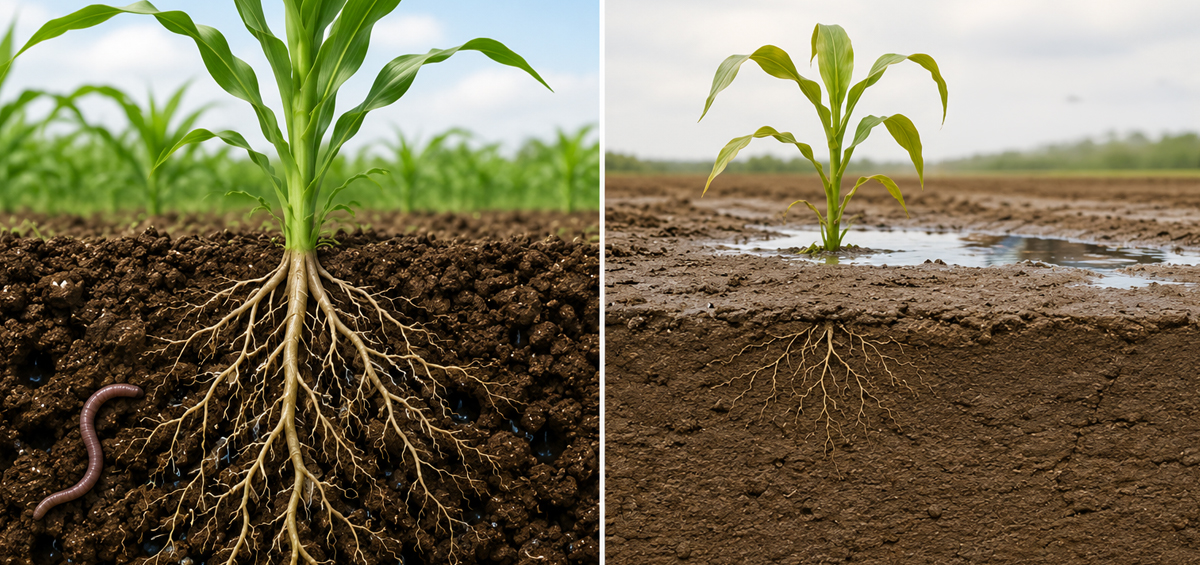
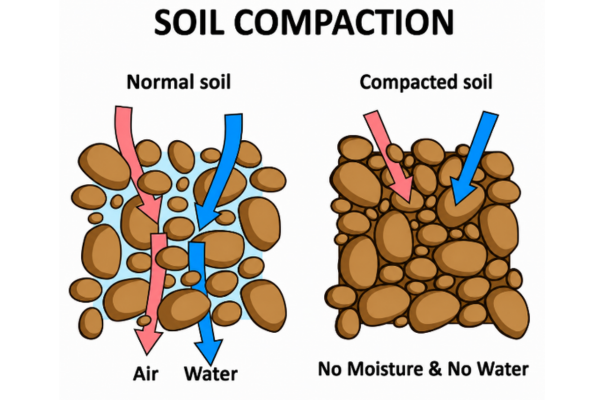
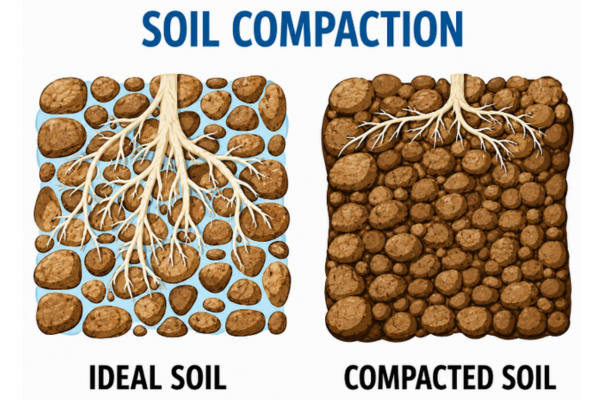
Soil compaction occurs when soil particles are pressed tightly together, reducing the pore spaces needed for air, water, and root movement. Healthy agricultural soil usually has a bulk density below 1.4 g/cm³ and penetration resistance below 1.5 MPa, allowing roots to grow freely and water to infiltrate easily. Organic matter above 1-3% helps maintain stable soil structure and supports microbial activity. In well-structured soil, oxygen reaches the root zone, roots grow deeper, and crops absorb nutrients efficiently.
When bulk density rises above 1.6–1.7 g/cm³, soil becomes compacted. Pore spaces collapse, reducing water infiltration and oxygen availability. Roots struggle to penetrate deeper layers and often spread sideways near the surface. This leads to weak root systems, poor nutrient uptake, lower drought tolerance, and reduced crop productivity.
Common causes of soil compaction include heavy machinery, repeated tillage, soil texture, soil type, livestock trampling, and low organic matter. Compacted soils become hard, reduce water and nutrient movement, restrict root growth, and lower fertiliser efficiency over time.
1. Alluvial Soil – Moderate compaction risk. Heavy machinery and excess irrigation can reduce pore spaces, affecting root growth and water drainage.
2. Black Soil (Regur Soil) – Highly prone to compaction because of high clay content. Compaction restricts root penetration and causes poor aeration and waterlogging.
3. Red Soil – Less prone to compaction due to its porous nature, but repeated tillage and low organic matter can harden the soil surface.
4. Laterite Soil – Can become hard and compact under heavy rain and erosion, reducing water retention and nutrient availability.
5. Arid and Desert Soil – Sandy soils compact less naturally, but surface crusting can occur, reducing seed germination and water infiltration.
6. Forest and Mountain Soil – Machinery use and deforestation increase compaction and erosion, limiting root development on slopes.
7. Saline and Alkaline Soil – Sodium causes soil particles to disperse, leading to hard compact layers and poor drainage.
8. Peaty and Marshy Soil – Excess moisture and high organic matter make soils soft, but drying can create dense compact layers affecting root growth.
Compacted soil restricts root penetration and development. As a result, plants develop shallow and weak root systems, reducing nutrient and water uptake. Crops also become less tolerant to drought and lodging.
Water enters compacted soil slowly, leading to surface runoff and water stagnation. This increases soil erosion and reduces irrigation efficiency.
Healthy roots and soil microbes need oxygen. Compaction reduces air spaces in soil, lowering root respiration and microbial activity, which affects nutrient cycling.
Restricted roots cannot absorb nutrients efficiently. Deficiencies of nitrogen, potassium, zinc, and sulphur are common, causing yellowing, stunted growth, and weak plants.
Compaction affects seed germination, root growth, and water availability, leading to uneven crop stands and lower productivity. Severe compaction can reduce yields by 10–50%.
Reduced infiltration increases runoff, which removes fertile topsoil and causes nutrient loss and sedimentation in nearby water bodies.
Earthworms and beneficial microbes decline in compacted soils, reducing organic matter decomposition, soil fertility, and natural soil structure formation.
Compacted soil can be improved with proper management practices.
Long-term soil health depends on maintaining good organic matter levels and reducing unnecessary soil disturbance. Healthy, well-aerated soil supports stronger roots, better microbial activity, efficient nutrient use, and sustainable crop yields.