UPI Payment





Bright, juicy, and packed with health-boosting Vitamin C, citrus fruits are a true pride of Indian farming. From Nagpur Mandarins and Punjab Kinnows to local Acid Limes, these popular fruits bring income to millions of hard-working farmers and fresh energy to our everyday diets.
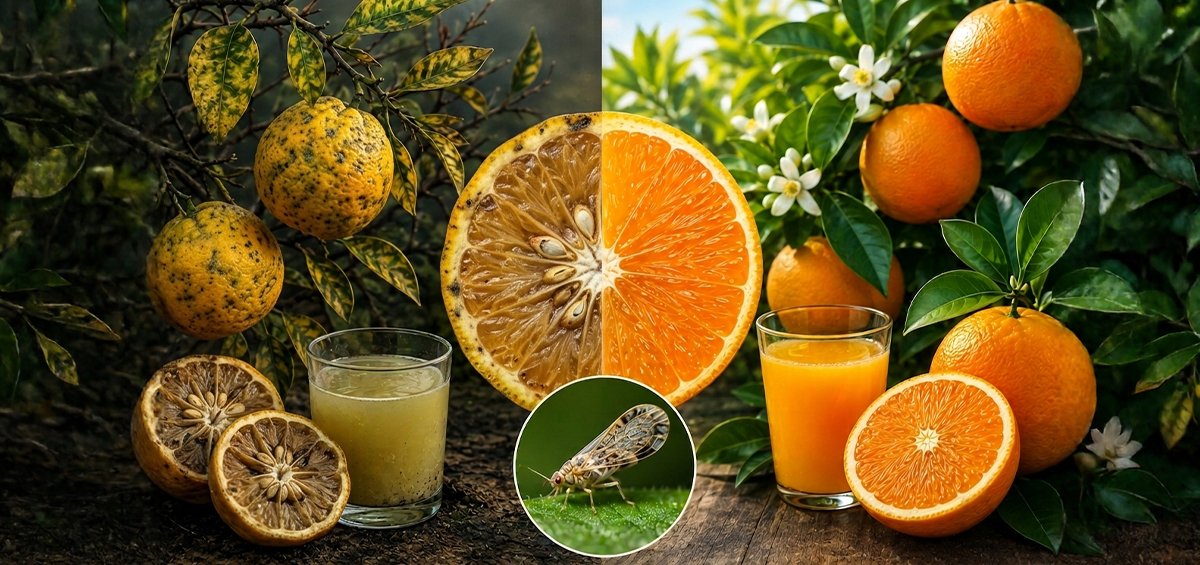
However, a serious disease known as Citrus Greening—also called Huanglongbing (HLB) or Yellow Dragon Disease—is silently destroying citrus orchards across India. Caused by a phloem-inhibiting bacterium (Candidatus Liberibacter) and spread by a tiny insect called the Asian citrus psyllid, it attacks the tree's vascular system and blocks the flow of vital food and water. It has already spread across 16 major farming states, causing leaves to turn yellow, branches to dry up, and crop yields to drop by up to 40%.
The damage reaches straight inside the fruit itself. Because the tree cannot deliver nutrients to the growing fruit, natural sugars vanish while harsh acids and off-tasting bitter compounds shoot up dramatically. Instead of sweet, refreshing juice, farmers are left with small, misshapen, and bitter fruit that no one wants to buy—threatening the livelihood of entire farming families across the nation.
Spotting Citrus Greening (HLB) early is the key to protecting your orchard. Because the disease blocks the flow of food inside the tree, symptoms quickly show up on both the leaves and the developing fruit.
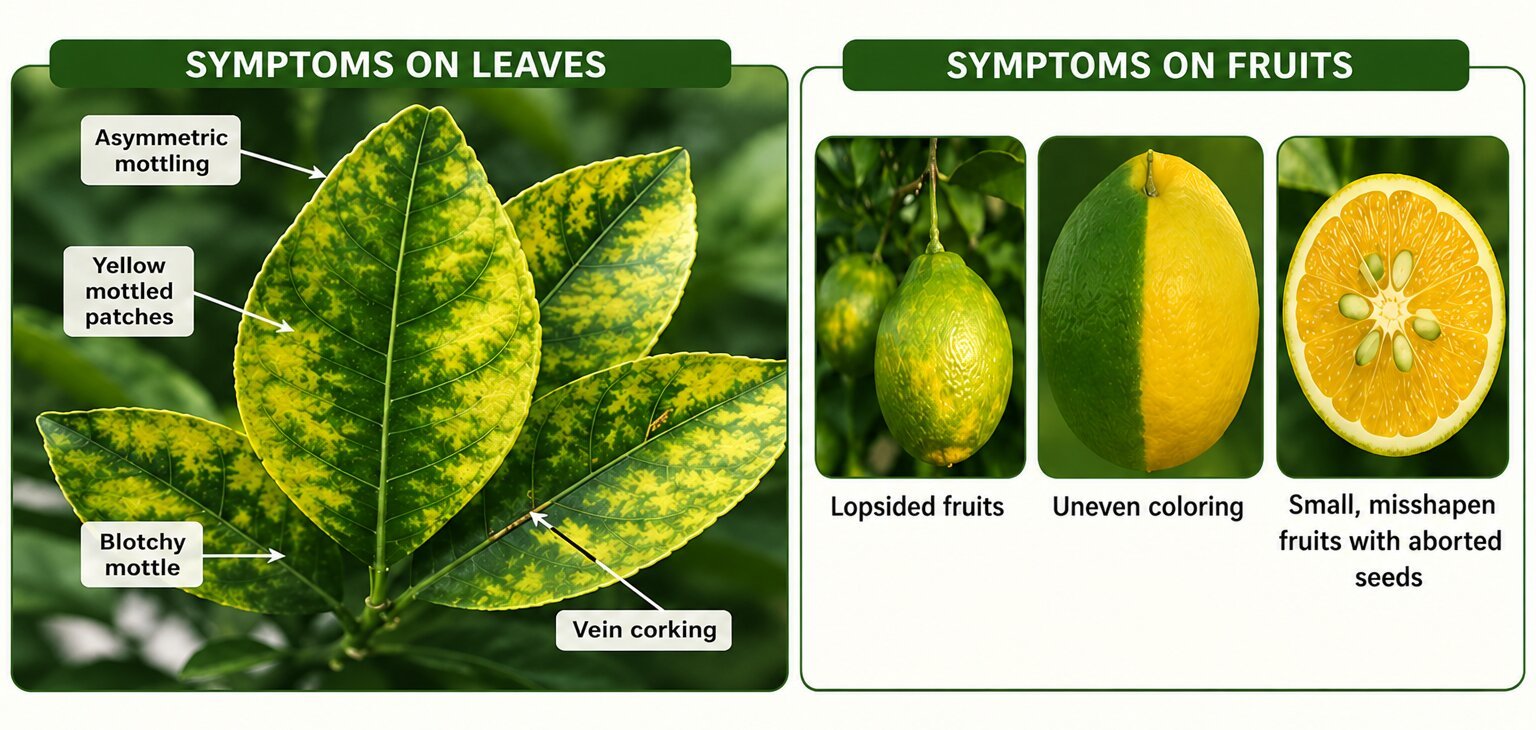
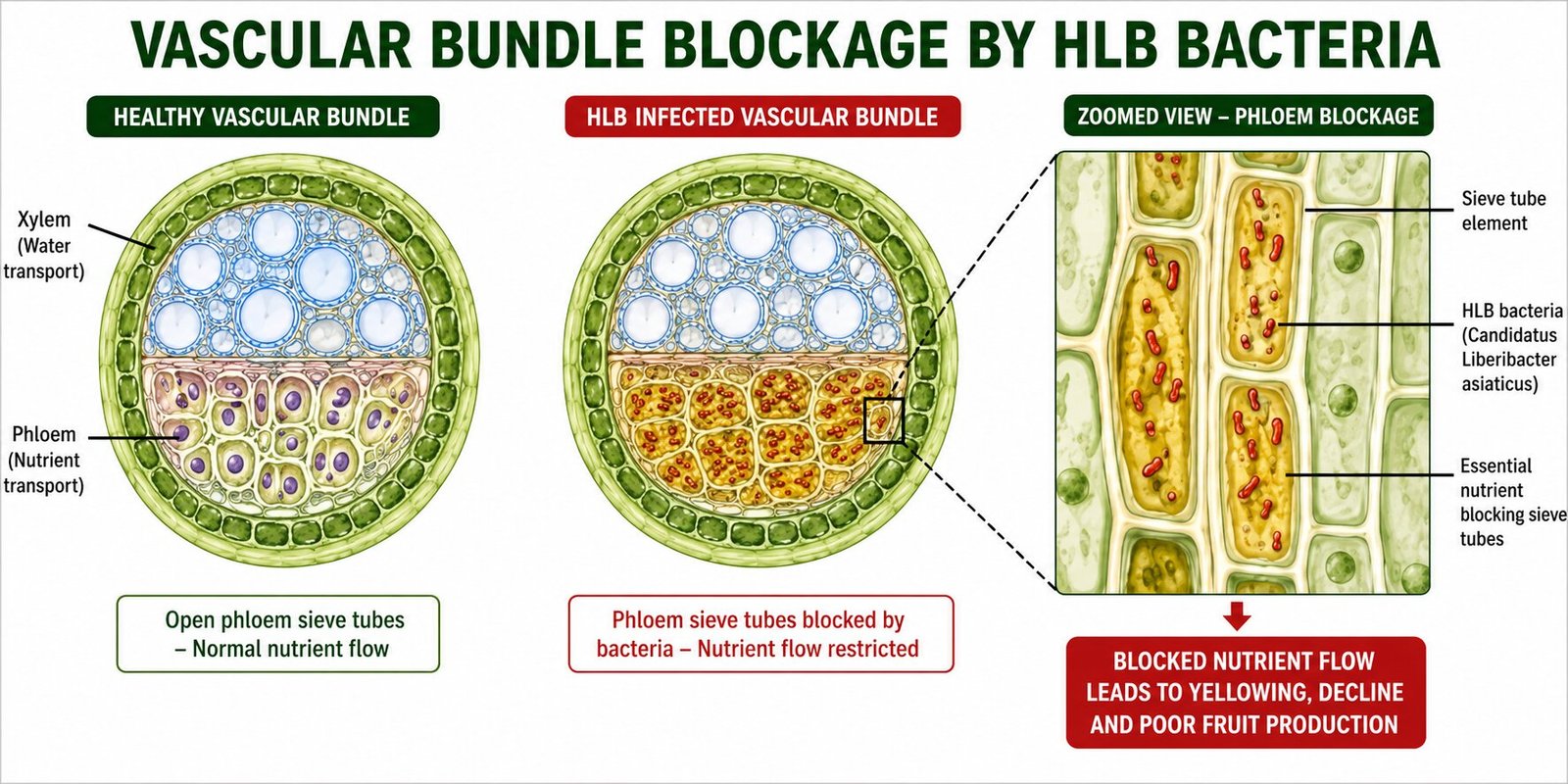
Citrus greening causes yellowing leaves, often mistaken for zinc or iron deficiency. Fertilizers cannot cure HLB, making accurate diagnosis essential to protect your orchard.
Here is how farmers can easily spot the difference in the field:
| Feature | Citrus Greening (HLB) | Zinc / Iron Deficiency |
|---|---|---|
| Leaf yellowing | Asymmetrical, blotchy yellowing | Symmetrical, uniform yellowing |
| Distribution | Random yellow shoots/branches | Usually widespread and uniform |
| Veins | Veins may become raised and corky | Veins generally remain green |
| Fruit | Small, lopsided, poor-colored fruit | Usually normal shape and color |
| Treatment response | No recovery with nutrient sprays | Improves after nutrient correction |
Vector Identification: Check tender new flushes for tiny, mottled-brown adults of Citrus Psyllid (Diaphorina citri) held at an inclined angle and yellowish-orange nymphs with white waxy secretions.
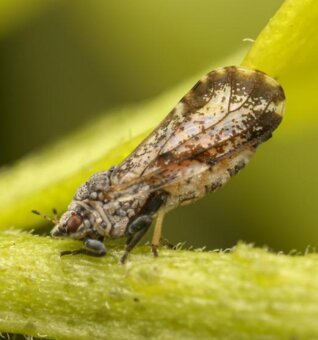
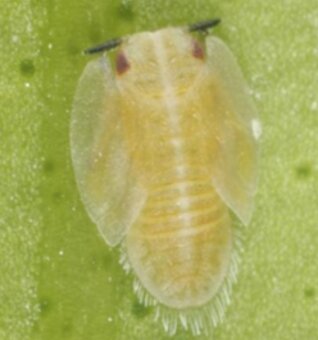
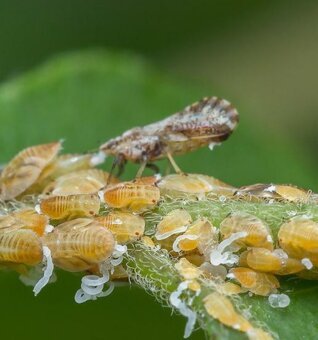
Early detection is critical for managing Citrus Greening (HLB). Spotting early symptoms on leaves, fruits, and roots enables immediate action before the disease spreads to neighboring trees.