UPI Payment





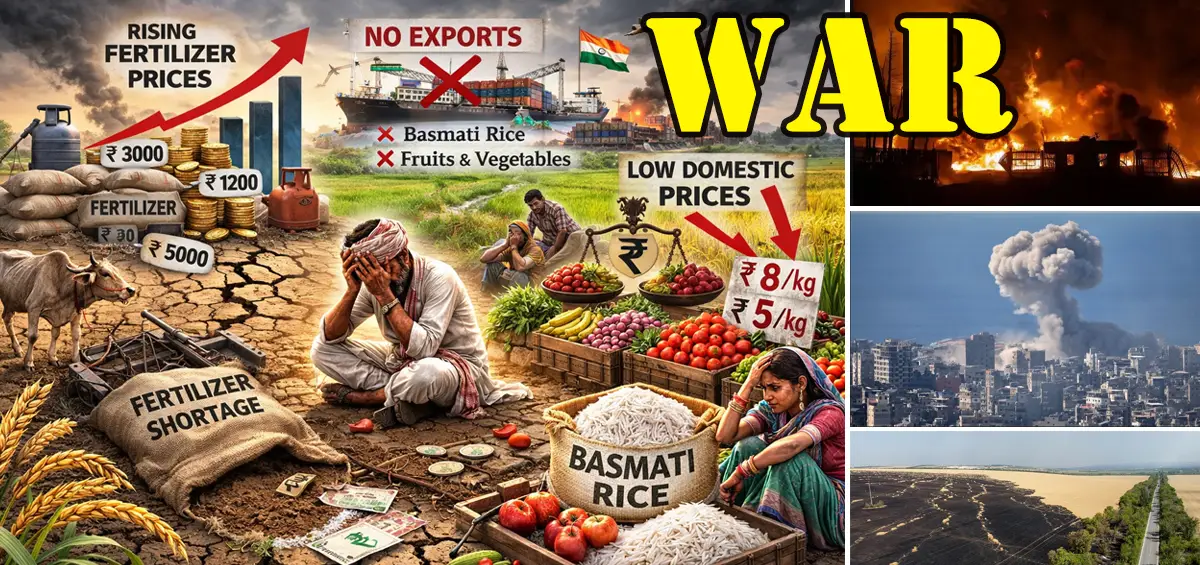
There is an old African proverb: “When two elephants fight, it is the grass that suffers.” In today’s geopolitical landscape, farmers are that grass. After the COVID-19 pandemic, just as the global economy began recovering, a new wave of geopolitical conflicts disrupted this fragile progress. Ongoing tensions, particularly in the Gulf region, have further intensified uncertainty.
As of 2025, India’s total fertiliser consumption stands at approximately 610 lakh tonnes, making it one of the largest consumers globally. of this, nearly 205.57 lakh tonnes are imported.
India depends heavily on countries such as China, Russia, Saudi Arabia, Morocco, and Oman for fertiliser imports. This dependency exposes the agricultural sector to global supply chain disruptions, especially during geopolitical conflicts.
During the Kharif season of 2025 (June–August), several states experienced acute urea shortages due to war-related supply disruptions. Experts caution that similar shortages may recur in 2026 if tensions persist.
In addition to supply constraints, raw material costs have risen sharply. In the international market, urea prices are averaging around 64,088 rupees per tonne. This translates to a procurement cost of approximately ₹2,880 per 45kg bag for the Indian government, excluding logistics and tariffs.
To mitigate the damage caused by the current war with the U.S.A., Iran is seriously considering imposing a tax on ships passing through the Strait of Hormuz. If Iran implements this, the input cost of fertilizers will increase sharply, which may force our government to raise the prices of major fertilizers. Currently, the government supplies urea to farmers at around ₹280 per bag, leading to a significant subsidy burden.
Another critical concern is the shortage of Liquefied Natural Gas (LNG)—a key raw material in urea production. India imports nearly 200 lakh tonnes of LNG annually, a significant portion of which comes from the Middle East. Supply disruptions have forced several domestic fertiliser plants to reduce production or temporarily shut down.
To mitigate this The Indian government, under the Essential Commodities Act, 1955, issued the Natural Gas (Supply Regulation) Order, 2026 on March 9, 2026, to prioritize gas supply for fertilizer production. Under this order, fertilizer plants have been classified as "Priority Sector II" and are assured a minimum of 65–70% of their six-month average gas consumption. This again emphasises the need of alternatives from farmers to reduce the use of chemical fertilizers.
Wars have also impacted agricultural exports. India exports commodities such as Basmati rice, frozen fruits, and vegetables to Gulf countries. Due to ongoing conflicts, exports to these regions have declined sharply, leading to domestic price crashes and further financial stress for farmers.
A complete and immediate shift to organic or natural farming may not be feasible for all farmers, as it can initially reduce yields. However, a gradual and strategic transition toward alternative nutrient sources can significantly reduce dependence on conventional fertilisers.
For instance, Multiplex Liquid N (32% nitrogen in three forms) can effectively substitute urea, while Multiplex Green Phosphorous, Multiplex Dab Plus, and Multiplex Green Potash serve as alternatives to conventional DAP and MOP. Multiplex Pranam Ca replaces Calcium Nitrate. Biofertilisers like Multiplex Organic Magik, Multiplex Nalpak, Multiplex Zinc B, and Multiplex Trishul Plus further enhance soil fertility and help plants utilise nutrients locked in unavailable forms and reduce the dependency on Inorganic fertilizers.
By gradually adopting alternative nutrient strategies and strengthening soil health, farmers can reduce vulnerability to geopolitical disruptions while ensuring stable productivity. The current global situation underscores a critical choice before Indian agriculture: continue relying on uncertain global supply chains or transition toward more resilient and sustainable farming systems.