
Welcome to Multiplex Group

Fusarium Wilt Decoded: Practical Tips for Healthy, High-Yield Watermelon Farming

15 December 2025

Watermelon (Citrullus lanatus) is a major cucurbit crop in India, valued for its taste and market demand. Yet production often faces losses from soil-borne diseases, with Fusarium wilt being one of the most destructive and persistent threats to watermelon cultivation.

Fusarium is a vascular pathogen that enters the plants through the roots, spreads inside the xylem. Its colonisation blocks the water and nutrient movement within the plant, disrupting its growth gradually, which results in progressive wilting, vine death, severe yield reduction, and in many cases, total crop loss.

Because watermelon has high market value and Fusarium wilt is a major threat, farmers and field workers need to understand its causes, conditions that favour it, symptoms, and ways to manage it effectively.
The Pathogen & Races of FON

  • Watermelon wilt is caused by Fusarium oxysporum f. sp. niveum (FON), which infects only watermelon.
  • Races of FON
  • There are four known races worldwide:
    1. o Race 0: Earliest, many old varieties were susceptible.
    2. o Race 1: Common observed pathogen, some varieties show resistance.
    3. o Race 2: More aggressive, overcomes resistance to race 1.
    4. o Race 3: Most virulent among all races.
  • In India, Race 1 and Race 2 have been reported infecting watermelon.

Favourable conditions for Fusarium wilt severity in India

  • Fusarium oxysporum f. sp. niveum becomes more severe in light, sandy soils low in organic matter, especially at slightly acidic pH (5.5–6.5) and optimal soil temperature of 25–27 °C.
  • When drought is followed by sudden irrigation/rain, stressed roots get minor damage and release more exudates, making them more prone to Fusarium infection.
  • Continuous cultivation of watermelon in successive seasons allows fusarium to persist and accumulate in the soil over the years.
  • In the presence of the Root-knot nematode, watermelon roots are damaged, which forms galls, and reduces water and nutrient uptake. The wounds they create make roots more vulnerable, allowing Fusarium to enter easily. Together, nematodes and Fusarium impose a combined stress that greatly increases wilt severity.

Symptoms & Disease Progression

  • Fusarium wilt in watermelon (caused by FON) begins with early symptoms such as sudden wilting or damping-off in seedlings, where young plants may collapse and die.
  • In older plants, the first signs include temporary daytime wilting and yellowing of older leaves, with partial recovery in the morning.
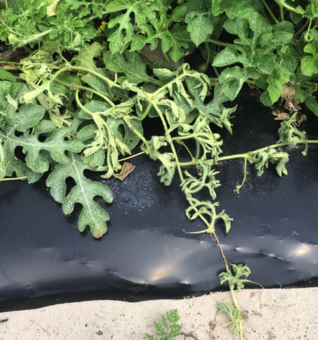
  • As infection advances, wilting becomes permanent, one or more runners die, and symptoms often start on one side of the plant, giving a unilateral wilt pattern before full collapse.
  • Internally, characteristic reddish-brown vascular discolouration appears in the xylem.
  • Stems may show cracks or crown lesions with brownish gum.
  • Affected plants become stunted, fruit set declines, and fruits that develop are usually smaller and poor in quality, leading to major yield loss.

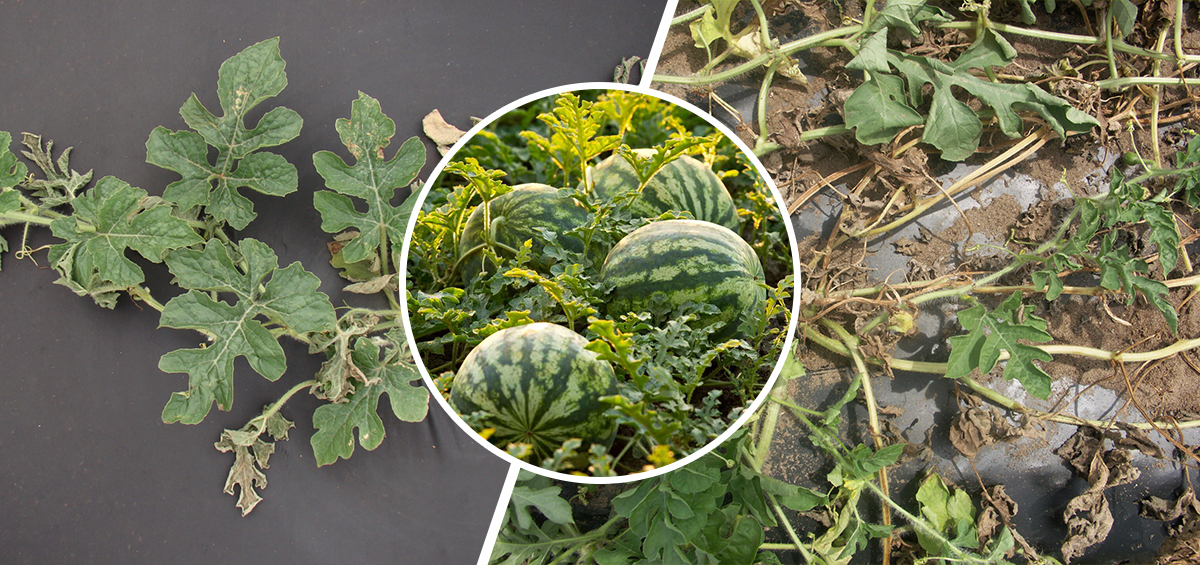
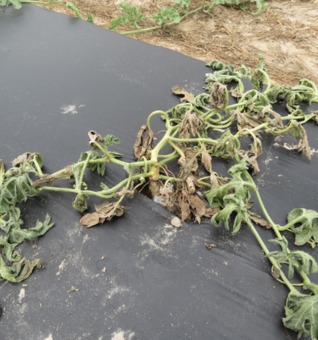
Wilting of the aboveground tissue. All leaves are wilted or necrotic.
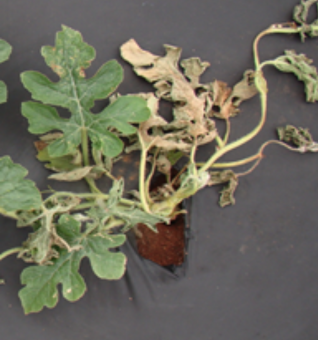
Wilting may begin on just one side of the plant.
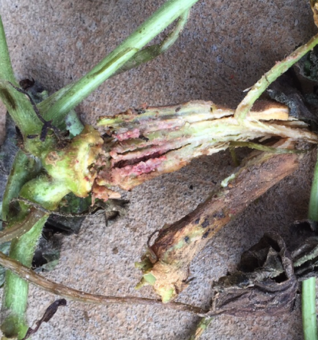
Pinkish vascular discolouration of the stem at the base of the plant is a characteristic symptom of Fusarium wilt.
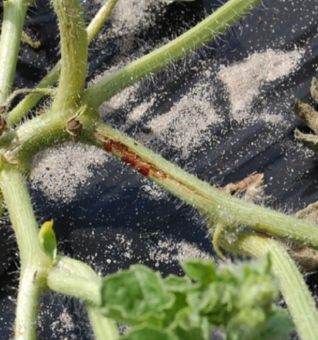
Sometimes sticky gum-like fluid oozes from cracked stems

Integrated Approach for Managing Fusarium Wilt

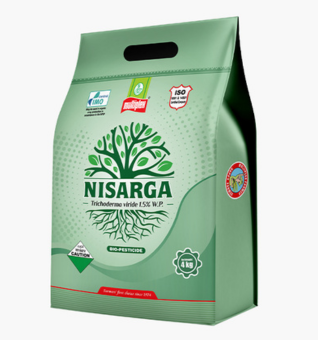
Because FON is soil-borne, persistent, and may have multiple races (including aggressive ones), management requires an integrated strategy combining cultural, biological, and (as needed) chemical approaches
Cultural Management
  • Avoid planting watermelon (or other cucurbits) in the same field repeatedly. Rotation with non-susceptible crops helps reduce inoculum build-up.
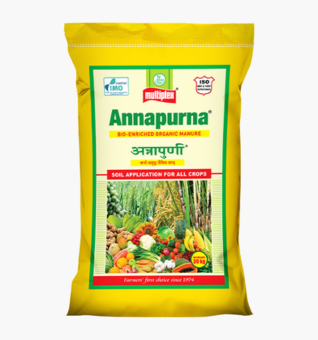
  • Since light sandy soils, low organic matter and slightly acidic or sub-optimal pH favour FON wilt, improving soil with organic amendments, maintaining good drainage, and avoiding waterlogging or prolonged moisture stress helps.
  • Avoid physical root injuries or damage, which can facilitate root invasion by a pathogen.
  • Excessive nitrogen fertilisation (especially ammonium-N) may exacerbate wilt severity.

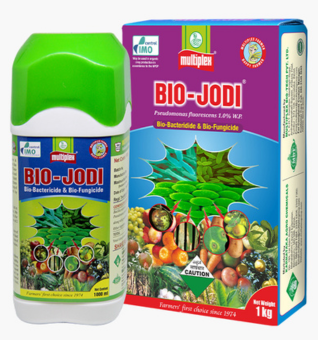
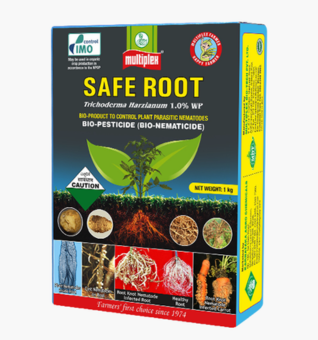
Biological Management

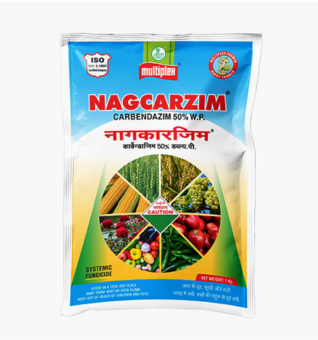
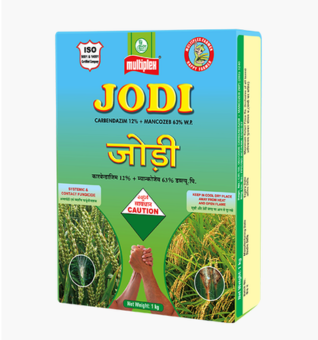
Chemical Management


Conclusion

Fusarium wilt in watermelon is persistent and destructive, but manageable at early stages. By integrating cultural, biological, and chemical practices, growers can reduce disease pressure, protect plant health, and maintain profitable yields even in infested fields

Recent Blogs

Project Image
Understanding Sigatoka Disease in Banana
Read more
Project Image
ALLBORICH: Advanced Liquid Boron for Higher Yields & Better Quality
Read more
Project Image
Understanding Phytoalexins and Their Role in Plant Disease Resistance
Read more