
Welcome to Multiplex Group

ALLBORICH: Advanced Liquid Boron for Higher Yields & Better Quality

12 November 2025

Boron is a critical but often overlooked micronutrient in plants — not required in large amounts like nitrogen or phosphorus, but vital for healthy growth, especially new growth and reproductive stages. Ensuring plants have adequate boron (without tipping into toxicity) is a key part of good crop nutrition.

Functions

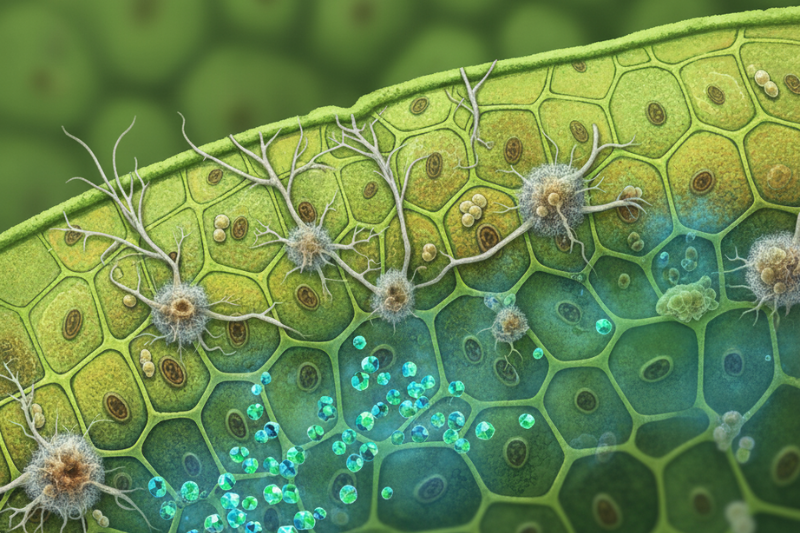
Boron is essential for plants because it strengthens cell walls and enables the transport of sugars and nutrients towards growing tissues, and supports flowering, pollen tube growth, and seed/fruit development.
Deficiencies
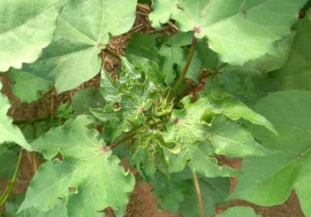
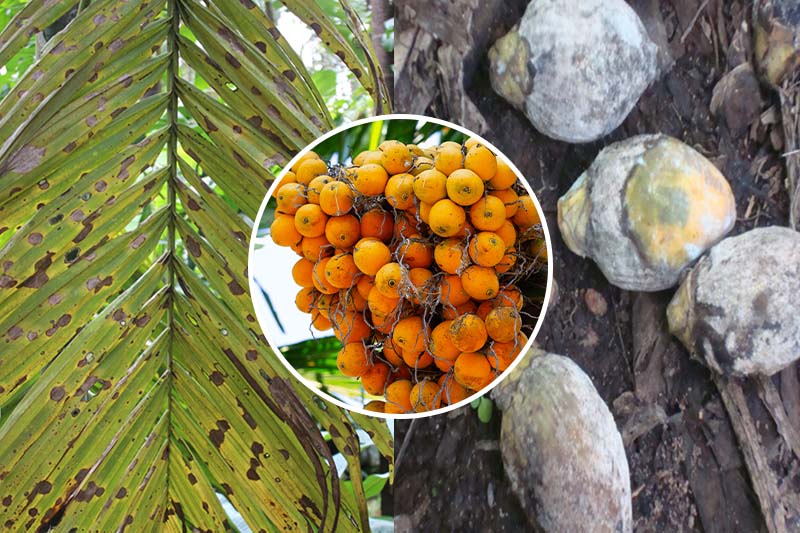
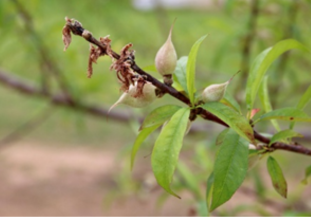
  • The youngest growing point may die or be distorted. Stunted growth, short internodes, bushy appearance due to suppressed elongation
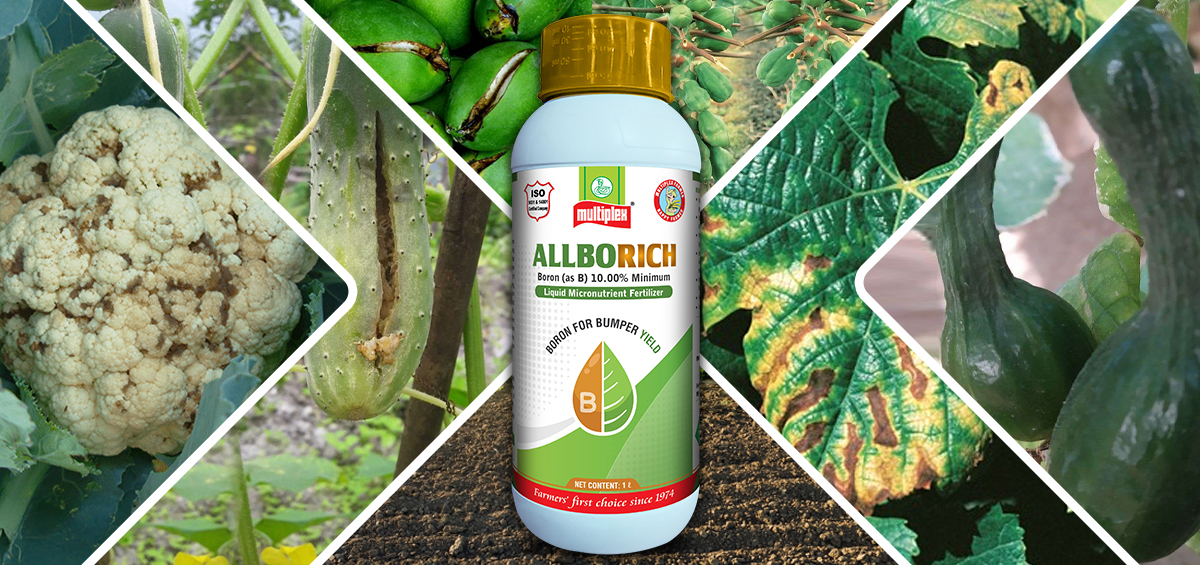
  • Young leaves may be distorted, thickened, brittle, or curled. They may display chlorosis (yellowing) or necrosis (death) at leaf tips or margins
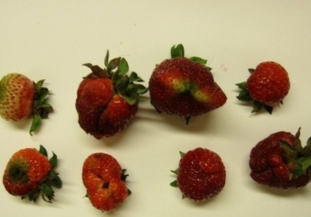
  • In fruit/nut crops- dieback of new shoots in pear occurs, followed by premature fruit drop and misshapen of strawberry fruit
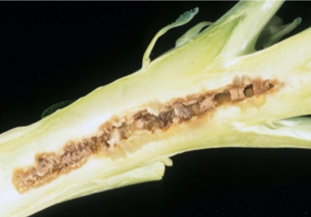
  • Brassica family crops (cabbage, cauliflower, broccoli): heads may have a hollow stem, brown heart and poor formation


Boron deficiency can be corrected using conventional boron fertilizers, where plants absorb boron in the form of boric acid. However, this form has several limitations, including immobility, low efficiency, and susceptibility to leaching. Its availability is also influenced by soil pH and limited compatibility with other nutrients.

Ethanolamine Boron: A Superior Alternative to Conventional Boron Fertilizers

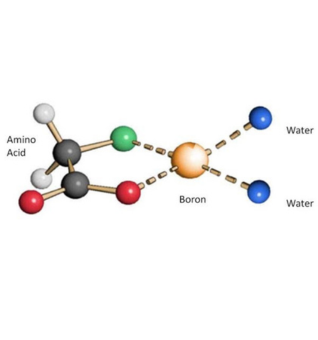
Ethanolamine boron fertilizers combine boron with ethanolamine (HO–CH₂–CH₂–NH₂) to provide a stable, plant-available form. They enhance boron absorption through leaves and roots, improve its mobility within plants, reduce leaching losses, and act as a stabilizing and delivery agent, ensuring efficient nutrient uptake and plant growth.

Comprehensive Comparative Analysis of Boron Fertilizers

Parameter Borax Boric Acid Disodium Octaborate Ethanolamine–Boron Complex
Chemical Formula Na2B4O7·10H2O H3BO3 Na2B8O13·4H2O C2H7NO·H3BO3
Chemical Name Sodium Tetraborate Decahydrate Orthoboric Acid Disodium Octaborate Tetrahydrate Monoethanolamine–Boron Complex
Boron Content (B) ~10–11% ~17–18% ~20–21% ~10% (varies by product)
Physical Form White crystalline powder or granules White crystalline powder White crystalline or granular powder Liquid micronutrient solution
Form Absorbed by Plants Boric acid (H3BO3) Boric acid (H3BO3) Boric acid (H3BO3) Boric acid (H3BO3) once taken up
Mobility in Soil Moderate; can move slowly with water High; easily leached in sandy soils Low; relatively stable High; moves easily due to chelation and solubility
Fertigation Suitability Moderate Good Excellent Very Good

Advantages of Ethanolamine Boron fertilizers over conventional fertilizers

  • This enhanced uptake supports key plant functions like pollen tube growth, seed formation, and nutrient transport.
  • Provides higher bioavailability, better nutrient compatibility, and enhanced tolerance to heat, drought, and salinity stress.
  • Reduces volatility and leaf burn in foliar sprays.
  • Buffers pH and improves leaf cuticle penetration (slightly amphiphilic).

New Generation Liquid Amino-Boron Formulation Launched by Multiplex

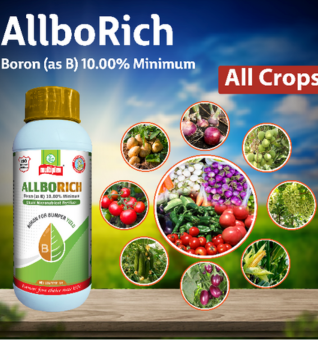
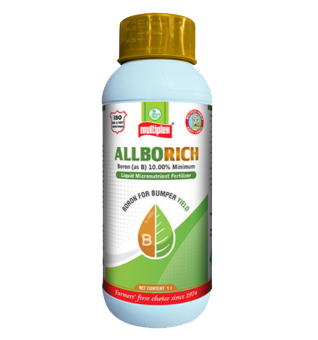
Multiplex has developed ALLBORICH, a liquid amino-boron product containing 10% boron in the form of ethanolamine, which demonstrates improved efficiency compared to conventional fertilizers.

This unique formulation contains adjuvants, eliminating the need to add any additional wetting agents or stabilizers. It helps all crops thrive even in challenging soils and under a wide temperature range (10–45°C), promoting healthier growth and higher yields. It serves as a micronutrient supplement to correct and prevent boron deficiencies in crops.
Dosage & Methods of Application

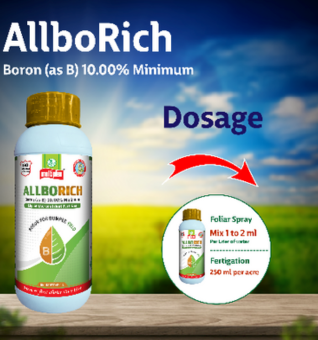
  • Foliar Spray: Mix 1 to 2 ml of Multiplex ALLBORICH in one Liter of water and spray on both surfaces of the leaves.
  • The first spray during beginning of flowering/fruiting and the second spray after fruit set and development.
  • Fertigation: Multiplex ALLBORICH can also be used for drip irrigation with the recommended dosage of 250 ml per acre.

Key Benefits of ALLBORICH (10% Boron Minimum)

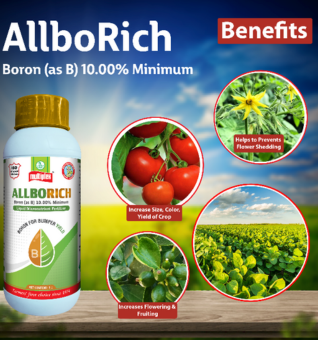
  • a) Enhanced Boron Availability The amino acid chelation improves boron solubility and uptake, even in challenging soil conditions ensuring consistent nutrient delivery.
  • b) Enhances pollen germination, tube growth, and viability, improving fertilization and fruit set while reducing flower shedding.
  • c) Supports seed development, cell wall formation, and maintains membrane integrity.
  • d) Promotes nitrogen fixation, nodulation in legumes, and aids calcium uptake.
  • e) Facilitates sugar translocation and carbohydrate metabolism through sugar-borate complexes.
  • f) Prevents fruit and berry cracking, nut splitting, and premature fruit& flower drop.
  • g) Increases fruit number per plant &per branch, improving both yield and quality.
  • h) Application before flowering boosts fruit set; after bloom enhances yield and storability.
  • i) Faster Deficiency Correction Foliar or soil application of amino chelated boron leads to quicker absorption and visible improvements in plant vigour and productivity.
  • j) Better Stress Tolerance : The amino acid component improves plant stress resistance, helping crops cope with heat, drought, or salinity—common challenges in horticultural production.

Ideal for: All crops

  • Fruit crops (e.g. mango, citrus, grapes, pomegranate)
  • Vegetable crops (e.g. tomato, cauliflower, capsicum)
  • Floriculture (e.g. rose, gerbera)

Recent Blogs

Project Image
The Tiny Giants of Agriculture: "Humic and Fulvic acids" that transform Soil Health
Read more
Project Image
Understanding Phytoalexins and Their Role in Plant Disease Resistance
Read more
Project Image
Battling Fungal Diseases in Arecanut: Safeguarding a Vital Plantation Crop
Read more