UPI Payment





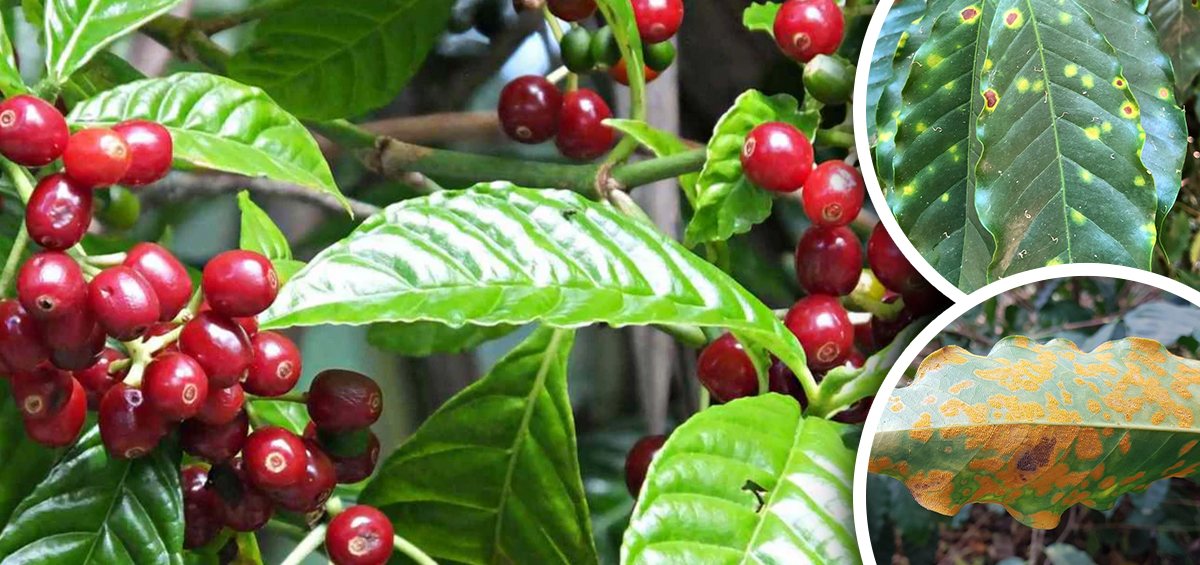
Coffee is more than a beverage; it’s a livelihood for millions of farmers across the tropics and a commodity worth billions of dollars in international trade. Yet, one microscopic fungus, Hemileia vastatrix, has become the most devastating threat to coffee production worldwide. Known as coffee leaf rust (CLR), this disease continues to spread across continents, leaving economic disaster and struggling farmers in its wake.
The first discovery of coffee rust dates back to 1861 in Africa, but its most infamous outbreak struck Sri Lanka in 1867. Within a decade, the flourishing coffee industry there collapsed, forcing planters to switch to tea—a shift that still shapes Sri Lanka’s economy today. Since then, rust has appeared in nearly every major coffee-growing country, including Brazil in 1970 and Hawaii in 2020.
Recent studies show that leaf rust is observed in major coffee-growing areas of Karnataka, with yield losses in severely affected plots ranging between 20 to 90%, depending on disease pressure and management.
Coffee rust typically starts as small yellowish or oily spots on the top of the leaves. On the underside, you’ll see orange-yellow powdery pustules filled with fungal spores. As the disease progresses, these lesions expand, turn reddish-brown, and eventually cause leaf drop. When many leaves fall prematurely, branches remain bare and the tree’s ability to photosynthesize is drastically reduced. This leads to smaller yields, lower bean quality, and even tree death if infections repeat year after year.
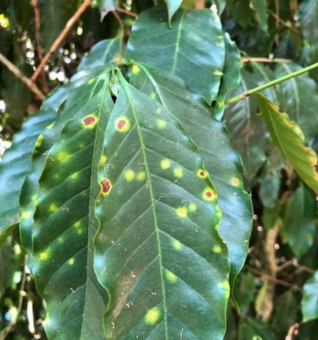
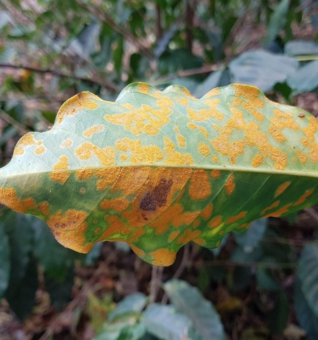
Unlike many plant pathogens, rust fungi require living host tissue to survive. Spores enter the leaf through natural openings and feed on plant cells. After several weeks, the fungus produces a new wave of spores, ready to be dispersed by:
Warm, humid conditions accelerate the disease cycle whereas cooler and drier conditions slow it down. However, with climate change driving warmer and wetter weather patterns, rust outbreaks are becoming more frequent and more severe even in higher-altitude plantations once considered safe.
The challenge of leaf rust lies in its adaptability. Plantations that rely on monocultures of a single coffee variety often create the perfect environment for new, more virulent strains of the fungus. Even resistant varieties can lose their defence over time. Arabica varieties are much more susceptible to leaf rust than robusta. Older Arabica varieties (Kents, Coorgs, etc.) are known to be more vulnerable. Dense planting and poor pruning cause limited air circulation, which can lead to high humidity, slower drying of foliage, which favours disease spread.